

The Man Who Called Himself “Nobody”: A Trap of Words in Homer's Odyssey
Outis, “Nobody”: the false name that fooled the giant Polyphemus. In Greek its sound rings five times within ten lines of Book 9, changing its meaning each time. We follow, line by line, the man who escaped by hiding his name and brought a curse on himself by revealing it.

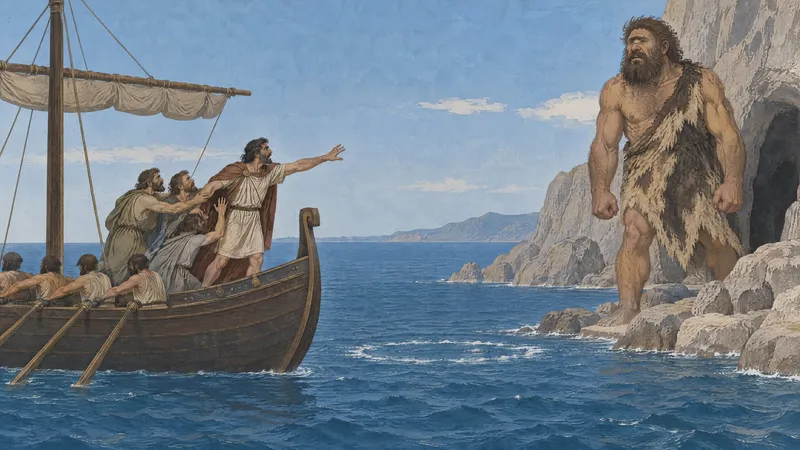
The film The Odyssey also includes the scene in the cave of the one-eyed giant Polyphemus. But the better you know the original, the more likely you are to have paused at one point. The famous exchange is missing, the one in which the hero, asked his name, answers “Outis” (“Nobody”).
It is a scene that does not come across easily on film, so it is understandable that it was left out. Heard in translation, “My name is Nobody” sounds like nothing more than a makeshift trick for children. How could a ploy like that deceive the giants?
In fact, the Greek original holds a rather delightful device. In the space of just ten lines, from line 405 to line 414 of Book 9, almost the same sound rings out five times, and each time its sense shifts. Ancient readers enjoyed this passage too, and the commentaries left in the margins of manuscripts even considered why the giants misheard. Let us follow the lines of the original in order, and listen for the sound the film did not let us hear.
“Tell Me Your Name, and I Will Give You a Guest-Gift”
Having put in at an island, Odysseus has blundered into the cave of Polyphemus. The exit is already sealed with a huge boulder, and several of his companions have lost their lives. Cornered, he offers the giant the strong wine he brought from the ship. After draining the first cup, the giant, now in good humor, asks for a second and at the same time asks his name: “Give me more, and gladly. And tell me your name right now, so that I may give you a guest-gift you will be glad of” (Homer Odyssey 9.355–356).
He is not asking the name and then handing over a gift; he is using the gift as bait to draw the name out first. In the scenes of this poem where a guest is received, the host asks who the stranger is only after the meal (ask the guest’s name after the meal). Here the order is reversed.
Odysseus does not answer at once. The land of the Cyclopes has wine too, says the delighted giant, but this is a drop of the drink of the gods (9.357–359). Odysseus pours three times, and three times the giant drains it (9.360–361). Once he sees that the wine has gone to the giant’s head, he gives his name in gentle words (9.362–363).
Οὖτις ἐμοί γʼ ὄνομα· Οὖτιν δέ με κικλήσκουσι μήτηρ ἠδὲ πατὴρ ἠδʼ ἄλλοι πάντες ἑταῖροι.
“My name is Outis. Outis is what they call me, my mother and my father and all my other companions.”
(Homer Odyssey 9.366–367)
The giant, as promised, announces his guest-gift: “Outis I will eat last among his companions, and the others before him. That shall be your guest-gift” (9.369–370).
The trap has been laid. But nothing has been set in motion yet.
It Sounds Like “Nobody Is Killing Me”
When the giant falls into a drunken sleep, Odysseus and his men heat a stake of olive wood in the fire and drive its point into the giant’s eye. He likens the motion to a shipwright boring a hole in a ship’s timber with a drill (Homer Odyssey 9.375–388). The giant’s screams echo beyond the cave.
From here, that act of naming begins to take effect. οὔτις originally means “no one,” an entirely ordinary word of negation. Odysseus had offered it, just as it was, as his own name. The name Οὖτις and the negative οὔτις are spelled alike; only the accent differs. When the poem was recited, the ancient audience may have heard that slight difference.
Hearing the screams, the Cyclopes who live in the nearby caves gather outside the stone door (9.399–401). Their question already contains the same sound.
ἦ μή τίς σευ μῆλα βροτῶν ἀέκοντος ἐλαύνει; ἦ μή τίς σʼ αὐτὸν κτείνει δόλῳ ἠὲ βίηφιν; τοὺς δʼ αὖτʼ ἐξ ἄντρου προσέφη κρατερὸς Πολύφημος· ὦ φίλοι, Οὖτίς με κτείνει δόλῳ οὐδὲ βίηφιν. οἱ δʼ ἀπαμειβόμενοι ἔπεα πτερόεντʼ ἀγόρευον· εἰ μὲν δὴ μή τίς σε βιάζεται οἶον ἐόντα, νοῦσον γʼ οὔ πως ἔστι Διὸς μεγάλου ἀλέασθαι, ἀλλὰ σύ γʼ εὔχεο πατρὶ Ποσειδάωνι ἄνακτι.
“Surely no one (mē tis) among mortals is driving off your flocks against your will? Surely no one (mē tis) is killing you yourself, by trickery or by force?” From inside the cave mighty Polyphemus answered them: “Friends, Outis is killing me by trickery, not by force.” And they answered him with winged words: “If no one (mē tis) is doing you violence, alone as you are, there is no escaping the sickness that great Zeus sends. Pray to your father, lord Poseidon.”
(Homer Odyssey 9.405–412)
Polyphemus’s answer almost traces the question from outside. The words “is killing” (κτείνει), “by trickery” (δόλῳ), and “by force” (βίηφιν) are carried straight over from the question. What has decisively changed is the subject. Where the giants outside said μή τις (“someone … surely not”), Polyphemus puts Οὖτις.
He believes he is naming the culprit precisely. But to those standing outside the stone door it can only sound like a negative sentence: “No one is trying to kill me.” The ancient commentary surmises that in his pain the giant could not make out the reply from outside, and that had he heard it, he could have corrected himself, “It was a man named Outis who did this to me,” and it concludes that this deception arose from the same sound carrying a different meaning (Scholia on Homer Odyssey 9.410).
This scene entertained ancient readers for a long time. Euripides, in his satyr play (a comic play staged after the tragedies) Cyclops, wrote the exchange “So where is Outis?” “Nowhere, Cyclops” (Euripides Cyclops 672–675b), and in a dialogue by Lucian, Polyphemus complains to his father Poseidon that when he answered “Outis,” the other Cyclopes thought he was raving and went home (Lucian Dialogues of the Sea-Gods 2.4).
In the end, no help came to Polyphemus.
The Name and the Wit Become the Same Sound
The voices outside fade away. Odysseus tells us what was in his heart at that moment.
ὣς ἄρʼ ἔφαν ἀπιόντες, ἐμὸν δʼ ἐγέλασσε φίλον κῆρ, ὡς ὄνομʼ ἐξαπάτησεν ἐμὸν καὶ μῆτις ἀμύμων.
“So they spoke as they went away, and my heart laughed within me, that my name and my flawless cunning (mētis) had so deceived them.”
(Homer Odyssey 9.413–414)
μῆτις (mētis), meaning “cunning” or “stratagem,” is made of the same sounds as the μή τις (“someone … surely not”) spoken by the giants outside, differing only in accent. This one line, in which Odysseus laughs inwardly, is itself the answer key for the reader.
Set those ten lines side by side, and the movement of the sound becomes visible. In lines 405 and 406 the giants outside ask μή τις twice; in line 408 Polyphemus answers Οὖτις; in line 410 the giants again reply μή τις; and in line 414 it lands on Odysseus’s μῆτις. As it rings five times, the same sound comes to point to three things: a false name, a word of negation, and a noun for the hero’s defining quality. All three are held within a single sound. You can check the Greek text and a parallel translation of this cave scene in Book 9 in Humanitext Reader.
That mētis is the very essence of this hero shows elsewhere in the poem as well. When he has finally ended his long wanderings and returned to his homeland of Ithaca, the goddess Athena appears before him and tells him: “You are by far the best of all mortals in counsel and in speech, and I among all the gods am famed for wit (mētis) and cunning” (Homer Odyssey 13.297–299). The word that ranks the goddess beside the hero was, it turns out, already contained in the single word he gave as his name in the cave.
“Nobody” is more than a simple quip. It was a name that captured in one word what this man survives by.
The Man Who Cast Off His Name Shouts It Aloud
The blinded giant moves the stone door aside, sits at the exit, and spreads his hands, meaning to catch anyone who tries to slip out among the sheep (Homer Odyssey 9.415–418). During the night Odysseus ties the sheep together in threes and binds his companions under their bellies, while he himself clings to the fleece on the belly of the largest ram of the flock (9.427–435). When dawn comes, the giant feels along the back of each sheep as it goes out. That men are tied beneath their bellies, he does not notice (9.437–443).
The giant strokes the back of the ram as it goes out last, and speaks to it. Why are you last today, when you always lead the way? Or are you grieving for your master’s eye, the eye that the villain Outis put out after robbing me of my wits with wine? He has not yet escaped destruction (9.447–455). Not knowing that his enemy is clinging beneath the very spot his hand is touching, the giant goes on cursing “Outis.” The false name had worked perfectly up to this point.
Back on the ship and rowing out to sea, Odysseus jeers at the giant on the shore. Enraged, the giant tears off the top of a mountain and hurls it, and the rock falls just ahead of the ship; the wave it raises pushes the ship back toward the shore (9.473–486). When, farther out, he is about to shout again, his companions desperately try to stop him. Why provoke such a savage? We nearly died a moment ago (9.491–499). Still he shouts.
Κύκλωψ, αἴ κέν τίς σε καταθνητῶν ἀνθρώπων ὀφθαλμοῦ εἴρηται ἀεικελίην ἀλαωτύν, φάσθαι Ὀδυσσῆα πτολιπόρθιον ἐξαλαῶσαι, υἱὸν Λαέρτεω, Ἰθάκῃ ἔνι οἰκίʼ ἔχοντα.
“Cyclops, if anyone among mortal men asks you how your eye came to be so shamefully blinded, say that Odysseus, sacker of cities, put it out, the son of Laertes, who has his home on Ithaca.”
(Homer Odyssey 9.502–505)
Had he remained Outis, the giant would not have known whom to curse. His name, his father’s name, and the name of his homeland: receiving these three, the giant stretches his hands to the starry sky and prays to his father Poseidon. Grant that Odysseus, sacker of cities, the son of Laertes, who has his home on Ithaca, never reaches home. Or if it is his fate to return, let him come late and in misery, having lost all his companions, on a ship not his own, and find troubles in his house (9.528–535).
The phrases in the prayer, “Odysseus, sacker of cities” and “the son of Laertes, who has his home on Ithaca,” are the very words of the boast just before. Line 531 in particular is identical, word for word, to line 505 of the boast. The giant was reading back, exactly as given, the name and address he had just been handed. This prayer becomes the premise of all the wandering that follows.
The wit to hide his name saved his life; the pride to reveal it decided what lay ahead.
When you think back on the cave scene in the film, remember this one word that did not ring out there. If you would like to look further into how the ancients read this name, put your questions to the original text in Humanitext Antiqua.
Related articles: Ask the Guest’s Name After the Meal: The “Law of Zeus” in the Odyssey / The Odyssey: “Nostalgia” Was the Pain of Being Unable to Return / Athena in the Odyssey: How Do Homer and the Film Differ? / The God Who Makes Men Forget, the Man Who Will Not: The Ending of the Odyssey
More on The Odyssey on Screen and in Homer
The God Who Makes Men Forget, the Man Who Will Not: The Ending of the Odyssey
For anyone left unsettled by the ending of the film The Odyssey. The original goes on after the suitors are killed, and it closes with a god making the people forget so that peace can follow. How did the film change that ending? Two endings, on forgetting and memory, read side by side from the lines of the poem (the film's ending is discussed).
Athena in the Odyssey: How Do Homer and the Film Differ?
Why does the film's Athena neither save the hero nor blame him? Set her beside the goddess of the original, who shares her cunning with Odysseus and intervenes at every turn of his homecoming, and the film's design comes into focus.
Ask the Guest's Name After the Meal: The “Law of Zeus” in the Odyssey
The suitors eat and drink their way through Odysseus's house. What is the “law of Zeus” that governs the treatment of guests? Scenes of hospitality in Homer's Odyssey show how a guest should be received, and how far the suitors have strayed from it.
The Odyssey: “Nostalgia” Was the Pain of Being Unable to Return
The opening lines of the poem behind the film The Odyssey hold the two words that would later give us “nostalgia”: homecoming and pain. A guide to the original, where the hero weeps on a shore he cannot leave, and endures.