

The God Who Makes Men Forget, the Man Who Will Not: The Ending of the Odyssey
For anyone left unsettled by the ending of the film The Odyssey. The original goes on after the suitors are killed, and it closes with a god making the people forget so that peace can follow. How did the film change that ending? Two endings, on forgetting and memory, read side by side from the lines of the poem (the film's ending is discussed).

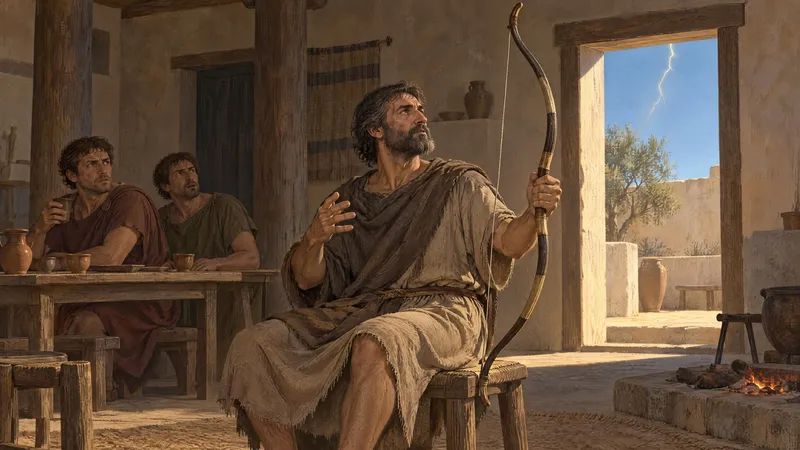
This article discusses the ending of the film The Odyssey.
For reading before you see the film, see Ask the Guest’s Name After the Meal: The “Law of Zeus” in the Odyssey and The Odyssey: “Nostalgia” Was the Pain of Being Unable to Return.
ἔκλησιν θέωμεν — let us set a forgetting upon it. (The original: the gods’ final decision)
Wrongs are forgotten, and then repeated. (The film: words spoken on the ship)
You may have come out of the film The Odyssey with its last scene still snagged on something. A man who has taken twenty years to reach his home, Ithaca, hands the throne to his son and puts out to sea again, with his wife beside him. A story about coming home ends with one more departure. And on the ship he says: wrongs are forgotten, and then repeated.
Homer’s Odyssey, the original, is entirely different here. Of its twenty-four books, the one in which the hero kills the men who had been squatting in his house is Book 22. The story goes on after that, and the decision the gods hand down in the final scene is, in a word, to make the people forget.
The original ends with a god making men forget; the film ends with men leaving a song so that they will not forget. This article traces that difference through the lines of the poem.
“Let Us Set a Forgetting Upon It”: An Ending a God Brings About
First, what happens at the end of the original. During the twenty years Odysseus was kept away by war and wandering, the sons of the leading families of the region forced their way into his house at home. They courted his wife Penelope, stayed on, slaughtered his livestock, and feasted every day. Odysseus, back in the house disguised as a beggar, kills every one of them.
In the original the fighting does not simply break out. After he has brought down the first man, the words in which he reveals himself begin by counting up the suitors’ crimes.
ὦ κύνες, οὔ μʼ ἔτʼ ἐφάσκεθʼ ὑπότροπον οἴκαδʼ ἱκέσθαι
δήμου ἄπο Τρώων, ὅτι μοι κατεκείρετε οἶκον,
δμῳῇσιν δὲ γυναιξὶ παρευνάζεσθε βιαίως,
αὐτοῦ τε ζώοντος ὑπεμνάασθε γυναῖκα,
οὔτε θεοὺς δείσαντες, οἳ οὐρανὸν εὐρὺν ἔχουσιν,
οὔτε τινʼ ἀνθρώπων νέμεσιν κατόπισθεν ἔσεσθαι·
νῦν ὑμῖν καὶ πᾶσιν ὀλέθρου πείρατʼ ἐφῆπται.“Dogs! You never thought I would come home again
from the land of the Trojans, and so you devoured my house,
lay by force with the serving women,
and courted my wife while I myself was alive,
fearing neither the gods who hold the wide heaven
nor any retribution from men that might come after.
Now the ropes of destruction are fastened on you, one and all.”(Homer Odyssey 22.35–41)
They devoured his house, took the serving women by force, courted his wife while her husband was alive. Before he kills them, he lists what they did. With this one move, the killing about to begin takes the form not of private revenge but of punishment for crimes. When the killing is over he insists on it again: these men fell by the doom of the gods and by their own wicked deeds (22.413–416). The Odysseus of the original feels no guilt over the killing of the suitors. What there is, is pollution, and the rite that removes it. He has the nurse bring sulfur and fumigates the hall to purify it (22.481–482). No one tells him to purify himself, and no one tells him to leave the island.
One problem remains: the kinsmen of the dead. He has the singer play the lyre, staging a wedding so that anyone passing outside will take it for one, to buy time (23.131–136). Even so the families gather, an assembly is called, and the father of Antinous, the ringleader of the suitors, makes his appeal in tears. Odysseus has done a monstrous thing to the Greeks. He took many fine men away in his ships and lost both ships and men, and now that he is back he has killed the best men we had (24.426–429). In the mouths of the bereaved, the companions lost at sea and the men killed in the hall stand side by side as the hero’s doing.
The families take up arms and advance. Here the original places a chilling line. Odysseus and his men would have killed them all and cut off their way home, had Athena not cried out and halted the whole army (24.528–530). Retribution, left to itself, does not end. So the original makes its final move. On Olympus, Zeus and Athena decide.
ἐπεὶ δὴ μνηστῆρας ἐτίσατο δῖος Ὀδυσσεύς,
ὅρκια πιστὰ ταμόντες ὁ μὲν βασιλευέτω αἰεί,
ἡμεῖς δʼ αὖ παίδων τε κασιγνήτων τε φόνοιο
ἔκλησιν θέωμεν· τοὶ δʼ ἀλλήλους φιλεόντων
ὡς τὸ πάρος, πλοῦτος δὲ καὶ εἰρήνη ἅλις ἔστω.“Since noble Odysseus has taken vengeance on the suitors,
let them swear binding oaths with sacrifice, and let him be king forever;
and let us, for our part, set a forgetting
upon the killing of their sons and brothers. Let them love one another
as before, and let there be wealth and peace in abundance.”(Homer Odyssey 24.482–486)
What is at work at the very end of the original is not reconciliation. It is forgetting. Because as long as they remember, the reprisals will go on, a god draws the memory out of the people. The single word at the head of the fourth line, ἔκλησις (eklēsis), is this; it means “a making-forget.” The arrangement is duly carried out: Zeus hurls a thunderbolt, and Athena tells Odysseus to stop the fighting (24.539–544). And his kingship is assured. The Greek text with a parallel translation of the close of Book 24 is in Humanitext Reader.
This ending sat uneasily even in antiquity. A scholion on Book 23, line 296, the scene in which Odysseus and Penelope go to bed, reports that the Alexandrian scholars Aristophanes and Aristarchus regarded this as the “end” (πέρας) of the Odyssey (schol. ad Od. 23.296). Whether the word means the conclusion or the climax is still disputed, but on either reading what follows, the uprising of the families and the god’s forgetting, falls in the part that the two of them placed after the poem’s point of arrival. That is exactly the part the film cut away.
A god erases; a king remains. That is the shape of the original’s ending.
The Sweetness of Forgetting: Oblivion in the Original
The forgetting that a god sets upon the people has already been shown once, in the first half of the poem, as a drug. In Sparta, what Helen mixed into her guests’ wine was a drug that dissolves grief and anger and makes one forget every ill. Whoever drank it, the poem says, could go without tears even if his father and mother died, even if his brother or his son were cut down before his eyes (4.220–226). What Zeus makes them forget in Book 24 is “the killing of their sons and brothers.” It is the same thing Helen’s drug made its drinkers forget. What the drug brought to an individual in the first half, a god sets upon the community at the end, without a drug, as a decision.
And in this poem the power that tries to make people forget always comes in a sweet form. The fruit of the lotus is sweet as honey, and the companions who eat it forget their homecoming and want to stay where they are (9.94–97). The drug Circe puts into a drink mixed with honey makes them forget their homeland and at the same time turns the companions into pigs (10.233–240). Calypso “charms him with soft and sweet words, so that he will forget Ithaca” (1.56–57). Forgetting is a comfort, and that is exactly why it is dangerous. The hero of this poem is a man who gets home by refusing that sweetness, again and again. If he sat on the beach weeping for seven years on Calypso’s island, it was because he did not forget (5.151–158).
Song has the same two faces. When the singer Phemius, in the house on Ithaca, sings of the wretched return from Troy, Penelope asks him to stop, because the song eats at her heart and calls up the memory of her husband (1.337–344). At the court of the Phaeacians, King Alcinous, watching a guest weep at the song of Troy, says this: “The gods fashioned it, and spun ruin for men, so that there might be a song for those yet to be born” (8.579–580). Song preserves memory. But for those who lived it, memory can be pain.
Forgetting is sweet, it heals, and it erases something. Read along this line, the ending of Book 24 is consistent. The story of a man who got home by not forgetting is closed by making the people forget. Only, the forgetting at the end has no sweetness. It is not a temptation but a god’s decision. In the original, forgetting becomes, in the end, a divine instrument for restoring order.
Permission to Forget: The Man Who Refuses It
The film does not use this instrument. The reason lies in where it places the cause of the disaster.
The original places the cause clearly, every time. And it places it on someone other than Odysseus. At the council of the gods in Book 1, Zeus explains: Poseidon keeps raging at this man because he blinded the Cyclops (1.68–75). As for the loss of all his companions, the narrator has already stated it in the proem: they perished by their own folly, for they ate the cattle of the Sun, which were forbidden (1.6–9).
The word used there, ἀτασθαλίη (atasthaliē, folly, reckless wrongdoing), echoes twice at the end of the poem. The first is the speech we have already seen, after he has finished with the suitors (22.413–416). The second is the assembly of the bereaved. On the very spot where the appeal is raised, the old man Halitherses stands up and answers: this is your own fault; you did not stop your sons in their recklessness (24.455–458). One and the same word acquits him of both mass deaths, the companions’ and the suitors’. And the last time it comes, it comes as the judgment of the town’s elder.
Exoneration also works as a permission: you need not remember. The proem had added this: he could not save his companions, much as he longed to (1.6). If the poem vouches even for what was in his heart, there is no reason for him to go on carrying their deaths as a debt. Each time it places the cause somewhere other than him, the poem lifts a weight off him. The forgetting brought to the bereaved in Book 24 is the finishing touch. What releases him in the end is other people’s forgetting.
The film uses this reasoning only once, and it puts it in a different mouth. On Thrinacia, the island of the Sun, the goddess Athena offers it to him: was it not their own doing? He refuses. What that scene means for the film’s Athena was the subject of Athena in the Odyssey: How Do Homer and the Film Differ?.
He does not only refuse the exoneration. By leaving the existence of the gods uncertain, the film gives up on fixing the cause at all. The difference shows most sharply in the scene of the trial of the bow. In the original, once he has strung the bow he plucks the string, and it sings out beautifully, like the voice of a swallow (21.410–411). The film follows this far. The difference comes immediately after. Zeus thundered loudly and showed a sign, the poem goes on, and much-enduring Odysseus rejoiced (21.413–415). In the original, the sound of the string gets an answer from a god. In the film, the sound of the string gets no such reply.
In a world without a reply, he has no choice but to decide his own deeds for himself. The film has a saying that is repeated throughout: those who come from the sea will destroy civilization. Right after they have sacked Ismarus, the people of the place ask them: are you the men who come from the sea? Much later, in the scene of his confession to his wife, Odysseus admits it. That is how he takes the guilt upon himself.
The Odysseus of the original declares a punishment, purges the pollution, has a god erase the grudge, and returns to being king. The Odysseus of the film takes responsibility for the disaster on himself. Having taken it, he has neither the standing of a king who carried out a just punishment nor a grudge that a god will erase for him. The man who refused exoneration has no god to wipe away his guilt. The ending in which he does not stay on the island as king comes from here.
Two Songs: One That Erases, One That Tells
The forgetting that the original placed on the side of the gods, the film moves to the side of human beings. Not as an instrument, but as a danger. On the ship heading west, he says it himself: wrongs are forgotten, and then repeated. The original’s forgetting worked to stop the reprisals, and ended once it had stopped them. The film’s forgetting happens on its own, depending on no one, and ends nothing. People forget, and do the same thing again.
Against this, what the film sets is song. Writing may disappear, the film says, but song remains. The script is lost, a dark age intervenes, and in time Homer appears. This is a reference to the condition of the film’s own existence, and at the same time an explanation of what he chooses at the end. The film opens with a bard singing the glory of the wooden horse, and at the end it burns that horse. The song of praise is burned; what remains is the confession of guilt he made to his wife.
Recall, here, the last song to sound in the house of the original. It was a false song, meant to make the killing look like a wedding (23.131–136). The song of the original sounds in order to cover up what happened. What remains in the film is a testimony that tells what happened as it happened. If forgetting means repeating, then leave a device for not forgetting. The role the original gave to a god, ending things by forgetting, the film replaces with a human ending: leaving it in memory.
It is not that the original knows nothing of memorials. Elpenor, the crewman who got drunk, fell from a roof, and died, asks Odysseus in the land of the dead: build a mound for me, and plant on it the oar I rowed with among my companions while I lived, so that people in later times may know of me (11.74–78). He does exactly that (12.13–15). This poem, too, raises a marker so that the dead will not be forgotten. And still, at the end, the poem chooses forgetting.
The original also foretells a journey after the homecoming. In the land of the dead, the seer Teiresias tells him: carry an oar on your shoulder until you reach a people who know nothing of the sea, plant the oar in the ground there, sacrifice to Poseidon, god of the sea, and then go home. Then a gentle death will come to you, in a prosperous old age (11.121–137). Even the original has a second journey ready. But it is a journey for making peace with the god and going home.
The film’s journey points the other way. Before setting out, Odysseus himself says that this is the last he will see of Ithaca. He is headed west, toward the setting sun, toward what he calls a world not yet seen. Those words had in fact appeared at the start of the film. Penelope, unwilling to see him leave for Troy, says: let us go west. Follow the fleeing sun, and beyond it there is a world. More than twenty years later, her husband puts out to sea with the same words. What had been a destination for escaping a war has become the destination of a man who has lost the place he was returning to. Except that his wife is on that ship. It can also be read as the two of them choosing, after the war, the life they did not choose before it. A journey so as not to forget the dead, or a journey to see a new world: the film does not commit itself to either.
A song that erases, and a song that tells. The original and the film give different jobs to the last song that sounds.
Who Remembers?
To put the difference in a sentence: the ending of the original restores order by having a god make people forget. The killing is declared a punishment, the pollution is purged, the grudge is erased by a god, and he returns to being king. Even the journey foretold was for the sake of coming back. The ending of the film is one in which people choose not to forget. He acknowledges himself as the cause of the disaster, gives up the throne, leaves words so that it will not be forgotten, and sets out for a world not yet seen. In the original a god sets the ending in place; in the film no one does. Instead, human beings remember.
Not that the film goes so far as to say that remembering one’s guilt is a solution. What follows is conjecture. The film’s wanderings leave out the island of Aeolus and the island of the Phaeacians, the places where guests are made welcome. The man who came from a sea where the law does not work says, in the confession scene, that breaking the law of Zeus spreads like a plague, and after killing the suitors he says that he has cut the fragile bonds between human beings. And the Greece he leaves behind has a dark age ahead of it. This ending, in which the man who chose memory goes out into the world, can also look like a picture of lawbreaking spreading across the world.
Still, how the film read the original is clear. The original is a world moved by gods and humans together, and both the cause of the disaster and the power to end it were spread across the two. The film pulled all of it over to the human side. The cause lies with me, he acknowledges; and it is we who end it, he entrusts to words. Once responsibility and will are both returned to human beings, forgetting turns from a blessing into a danger, and memory becomes the only resistance. The film’s ending is the consistent result of that reading.
There was someone in antiquity who came close to this reading: Plato. In the story of the afterlife placed at the end of the Republic, when the turn comes for the soul of Odysseus to choose its next life, it chooses not a life of honor but the quiet life of a private man whom no one notices. The reason, Plato writes, is that “by the memory of its former toils” it had been cured of ambition (Plato Republic 10.620c–d). Remembering makes him let go of being a king. No ancient text comes as close as this to the choice the film’s Odysseus makes.
The last song to sound in the original was a song to hide a killing. And what a god sets in place at the end was forgetting. What remains at the end of the film is words meant to tell what happened. A poem that ends with a god erasing the people’s memory, and a film that ends with a man leaving a song so that no one can erase it. If you would like to follow the words of the original directly, put your questions to the text in Humanitext Antiqua.
Related articles: Ask the Guest’s Name After the Meal: The “Law of Zeus” in the Odyssey / The Odyssey: “Nostalgia” Was the Pain of Being Unable to Return / Athena in the Odyssey: How Do Homer and the Film Differ?
More on The Odyssey on Screen and in Homer
Athena in the Odyssey: How Do Homer and the Film Differ?
Why does the film's Athena neither save the hero nor blame him? Set her beside the goddess of the original, who shares her cunning with Odysseus and intervenes at every turn of his homecoming, and the film's design comes into focus.
Ask the Guest's Name After the Meal: The “Law of Zeus” in the Odyssey
The suitors eat and drink their way through Odysseus's house. What is the “law of Zeus” that governs the treatment of guests? Scenes of hospitality in Homer's Odyssey show how a guest should be received, and how far the suitors have strayed from it.
The Odyssey: “Nostalgia” Was the Pain of Being Unable to Return
The opening lines of the poem behind the film The Odyssey hold the two words that would later give us “nostalgia”: homecoming and pain. A guide to the original, where the hero weeps on a shore he cannot leave, and endures.
Why Ancient Greeks Hated Philosophers: The Harshest Insults
Socrates was mocked as a poor chatterbox, and philosophers were dismissed as useless in real life. These ancient Greek and Roman insults reveal the irritation and unease that professional thinkers provoked.