

Deucalion's Flood and the Humans Born from Stone
Deucalion and Pyrrha survived Zeus's flood and followed an oracle to cast the 'bones of their mother'—stones of the earth—behind them. From those stones came a new human race.

What would you do if the world ended and you were the sole survivor? This is one of the fundamental questions posed by Greek mythology. Let us explore the story of a couple who survived a great flood unleashed by the wrath of the gods and, following a cryptic oracle, repopulated the earth in a most astonishing way.
Zeus’s Wrath and the Great Flood
The story begins when Zeus, king of the gods, resolves to destroy the humans of the “Bronze Age” (Apollodorus Library 1.7.2). Unable to tolerate their impious and violent ways, Zeus decided to wipe all of humanity from the face of the earth.
Zeus’s fury manifested as a torrential downpour from the heavens. But his anger was not sated by this alone. Poseidon, god of the sea, also aided his brother Zeus, striking the earth with his trident. The ground trembled, releasing subterranean waters, and every river burst its banks, flooding the open plains (Ovid Metamorphoses 1.274-286).
exspatiata ruunt per apertos flumina campos cumque satis arbusta simul pecudesque virosque tectaque cumque suis rapiunt penetralia sacris. […] Iamque mare et tellus nullum discrimen habebant: omnia pontus erant, deerant quoque litora ponto.
“The rivers, bursting their banks, rush over the open plains, sweeping away crops, orchards, cattle, men, and houses with their sacred inner shrines. […] And now sea and land had no distinction: all was ocean, and the ocean lacked a shore.”
(Ovid Metamorphoses 1.285–292)
Places that were once hills became islands, and men rowed their boats over the fields they had recently plowed. Fish were caught in the tops of elm trees, wolves swam among the sheep, and dolphins collided with oak trees in the forest (Ovid Metamorphoses 1.293-304). Soon, even the mountaintops were battered by new waves. Most living creatures were swallowed by the water, and those who survived eventually perished from starvation (Ovid Metamorphoses 1.309-312). Most of Greece was submerged; the mountains of Thessaly were split apart, and everything sank beneath the waves except for the Isthmus of Corinth and the Peloponnese (Apollodorus Library 1.7.2).
The Ark’s Journey and Arrival at Mount Parnassus
Yet, even in this catastrophic flood, a glimmer of hope remained. Prometheus, the god involved in humanity’s creation, foresaw Zeus’s plan and warned his son, Deucalion. Following his father’s advice, Deucalion built a great ark, loaded it with necessary provisions, and boarded it with his wife, Pyrrha (Apollodorus Library 1.7.2). Pyrrha was the daughter of Prometheus’s brother, Epimetheus, and Pandora, the first woman created by the gods.
The ark carrying Deucalion and Pyrrha drifted upon the raging sea for nine days and nine nights (Apollodorus Library 1.7.2). Eventually, their vessel came to rest on the summit of Mount Parnassus, the only peak that emerged from the vast expanse of water (Ovid Metamorphoses 1.316-319). No man loved justice more than Deucalion, and no woman revered the gods more than Pyrrha (Ovid Metamorphoses 1.322-323). Seeing their piety, Zeus commanded the North Wind to scatter the rain clouds, separating heaven and earth once more. Poseidon also laid down his trident and ordered Triton to sound his conch shell, causing the raging waters to gradually recede (Ovid Metamorphoses 1.324-342).
After many days, the land finally reappeared. But what the couple saw was a desolate world shrouded in silence (Ovid Metamorphoses 1.348-350). Deucalion spoke to Pyrrha through his tears: “O my wife, the only woman to survive, we two are all that is left on this earth. The sea has claimed all the rest.” Despairing that they were the only humans left, they decided to seek the help of the gods (Ovid Metamorphoses 1.351-368).
The Oracle of Themis and the Rebirth of Humanity
The pair made their way to the shrine of the goddess Themis, who once delivered oracles there. The temple was covered in moss and its altar fires were extinguished, but they prostrated themselves on the ground, kissed the cold stone, and offered a prayer (Ovid Metamorphoses 1.371-376). “O goddess Themis, if the anger of the gods can be softened by righteous prayers, show us how to restore our ruined race. Grant your aid to this sunken world” (Ovid Metamorphoses 1.377-380).
Moved by their prayers, the goddess bestowed upon them a cryptic oracle.
Discedite templo et velate caput cinctasque resolvite vestes ossaque post tergum magnae iactate parentis!.
“Depart from the temple, veil your heads, ungird your robes, and cast behind you the bones of your great mother!”
(Ovid Metamorphoses 1.381–383)
Hearing these words, the two were stunned for a long time. Pyrrha, in particular, was horrified by the sacrilegious act of casting her mother’s bones and refused to obey the divine command (Ovid Metamorphoses 1.384-387). But Deucalion pondered the oracle’s true meaning. Convinced that a divine command could not be wicked, he shared his interpretation with Pyrrha: “The great mother is the Earth. The stones within her body must be the ‘bones.’ We are commanded to throw these stones behind us” (Ovid Metamorphoses 1.391-394).
A New People Born from Stone
Although they found hope in Deucalion’s interpretation, doubt still lingered in their hearts. Yet, thinking there was no harm in trying, they veiled their heads, ungirded their robes, and began to pick up the stones at their feet and cast them behind them, just as the oracle had instructed (Ovid Metamorphoses 1.395-399).
Then, an incredible sight unfolded. The stones they threw began to lose their hardness and gradually soften. They started to take shape, transforming into the imperfect form of human beings, much like a statue in the early stages of being carved from marble by a sculptor (Ovid Metamorphoses 1.400-406). The moist, earthy parts of the stones became flesh, while the hard, inflexible parts turned into bone (Ovid Metamorphoses 1.407-410).
The stones thrown by Deucalion became men, and those thrown by Pyrrha became women (Apollodorus Library 1.7.2). Thus, by the power of the gods, humanity, which had been destroyed, once again filled the earth. It is said that from this myth, the Greek word for “people,” laoi (λαοί), was derived from the word for “stone,” laas (λᾶας) (Apollodorus Library 1.7.2).
This new humanity born from stone was “a hardy race, accustomed to toil,” and their very origin was a testament to their resilience (Ovid Metamorphoses 1.414-415). The story of Deucalion and Pyrrha, a tale of rising from the brink of annihilation to forge a future with wisdom and piety, has been passed down to this day as a magnificent myth of rebirth, symbolizing the indomitable spirit of humankind.
More on The Origins and Trials of Humanity
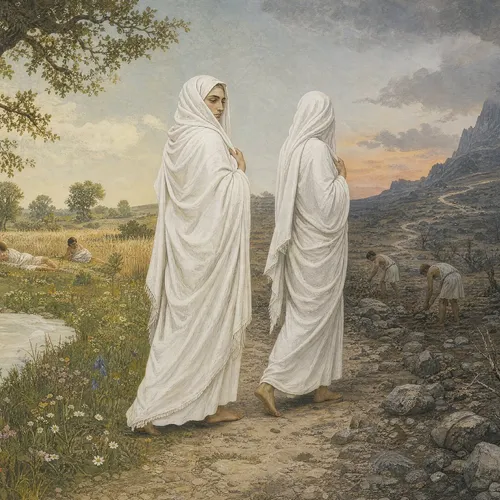
From the Golden Age to the Iron Age: Hesiod's Decline of Humanity
Hesiod divided human history into five ages: Golden, Silver, Bronze, Heroic, and Iron. Why did humanity decline, and how did he view his own age? Read the myth through Works and Days.
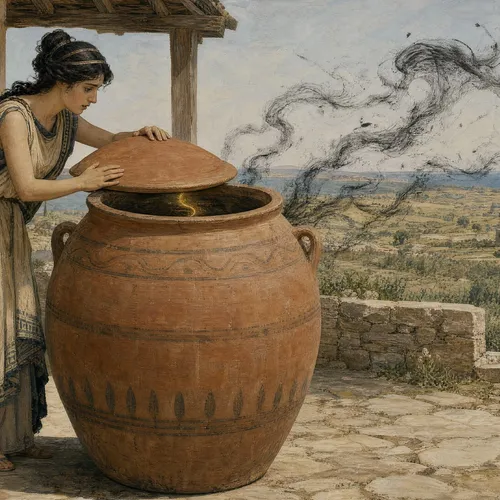
Why Was Hope Left in Pandora's Box?
Pandora's “box” was really a jar. When its evils escaped, only hope—elpis in Greek—remained. What did that ending mean? This article examines Hesiod's text and the ambiguity of hope.
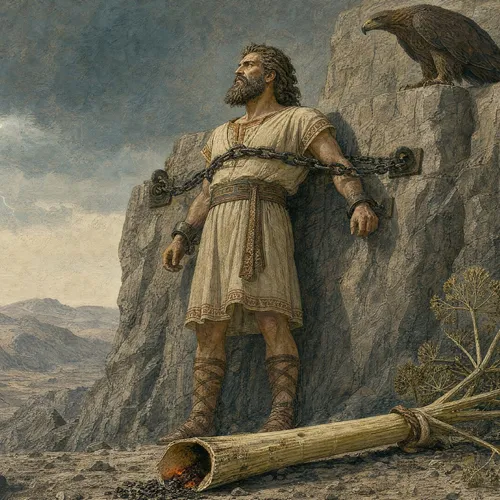
Why Did Prometheus Give Fire to Humanity—and Suffer Forever?
Prometheus defied Zeus and brought humanity fire and technology. For it, he was chained to a mountain while an eagle devoured his liver. Follow the myth from the theft of fire to his release in ancient sources.
Why Ancient Greeks Hated Philosophers: The Harshest Insults
Socrates was mocked as a poor chatterbox, and philosophers were dismissed as useless in real life. These ancient Greek and Roman insults reveal the irritation and unease that professional thinkers provoked.