

Invited Talk at the Brazilian Webinar "Classical Studies in the Age of Artificial Intelligence and the Digital Humanities"
10/22/2026
On October 20, 2026, the online webinar “Estudos Clássicos na Era da Inteligência Artificial e das Humanidades Digitais” (Classical Studies in the Age of Artificial Intelligence and the Digital Humanities) was held by the Permanent Forum of Classical Studies, Law and History of the School of Magistrates of the State of Rio de Janeiro (EMERJ), together with the Archai UNESCO Chair on the Plural Origins of Western Thought at the University of Brasília. It was the forum’s twelfth meeting, held on Zoom and streamed on the EMERJ-Eventos YouTube channel, with simultaneous interpretation into Portuguese.
Naoya Iwata (Nagoya University / National Institute of Informatics) gave the opening talk, invited by Gabriele Cornelli (University of Brasília). He was followed by three Brazilian speakers — Carlos Gustavo Direito (PUC-Rio), Anise Ferreira (UNESP) and Renato Matoso (PUC-Rio) — and Flavia Vasconcellos Amaral (University of Winnipeg) served as respondent.
The talk
Naoya Iwata, “Back to the Sources: Humanitext and Verifiable AI for Greek and Latin Texts” (from 15:29 in the recording)
The talk started from the observation that a fluent answer about an ancient text is of scholarly use only if it can be traced back to the passage it rests on. It presented Humanitext Antiqua and Humanitext Reader as two public services built on that principle, and contrasted decades of digitization for human readers and machine processing with the newer task of preparing texts that an AI can retrieve, reason over, and cite.
As a live demonstration, Antiqua was asked first how justice is defined in Justinian’s Digest, and then, in the same conversation and across the whole corpus, how Ulpian’s definition compares with Plato’s and Aristotle’s accounts of justice; the passages were then opened in Reader. The talk also described how the Digest text was prepared from the printed Mommsen–Krueger edition, how work is divided between AI and human checking, and the knowledge-graph project now beginning with support from Schmidt Sciences.
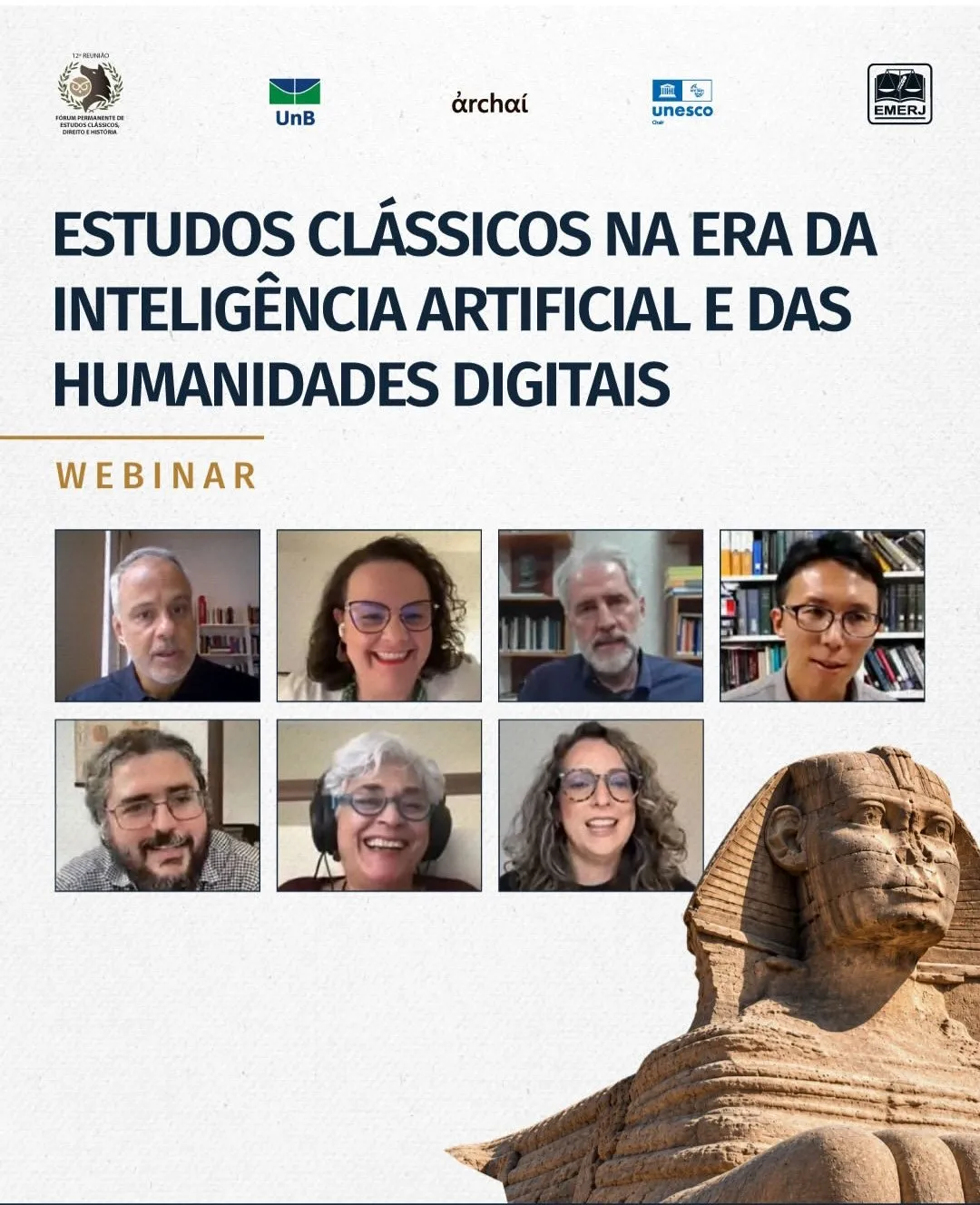
The full webinar, including the talks by the Brazilian speakers and the discussion, is available on the EMERJ-Eventos YouTube channel.