

After Chaos Came Gaia—and the Greek Cosmos Began
Greek myth begins with Chaos, a yawning void, followed by Gaia, Tartarus, and Eros. Follow Hesiod's Theogony from the first darkness to the birth of sky, mountains, and sea.

What was there before the world began? The ancient Greek poet Hesiod, in his epic poem Theogony, sang of the origins of the gods and the cosmos. It is a tale of creation and generation, beginning from the infinite, formless void of Chaos.
The “Chaos” Before All Things
The story opens in a primordial state, before gods or mortals, heaven or earth, existed. According to Hesiod, “Verily at the first Chaos came to be” (Hesiod Theogony 1.116). While modern ears might hear “chaos” and think of disorder, in the ancient Greek context, Chaos carried the nuance of a “void” or a “great chasm.” It was an infinitely vast, dark space holding the potential for all things to come into being.
From this fundamental Chaos, the first beings began to differentiate. First came Erebus (Darkness) and Nyx (Night), two forces symbolizing darkness (Hesiod Theogony 1.123). Then, from their union, the dark Nyx brought forth their opposites: Aether (celestial light) and Hemera (Day) (Hesiod Theogony 1.124–125). Thus, from the empty void came darkness, and from that darkness came light, establishing the fundamental duality of the cosmos.
The First Three - Gaia, Tartarus, and Eros
Following the birth of Chaos, three immense powers that would constitute the world appeared, almost simultaneously and spontaneously. They were Gaia (Earth), Tartarus (the Abyss), and Eros (Love). These beings were not created by anyone; they emerged from Chaos as a cosmic necessity.
First to appear was “broad-bosomed” Gaia, the Earth Mother. She was born to be “the ever-sure foundation of all” the deathless ones who hold the peaks of snowy Olympus (Hesiod Theogony 1.117–118). Gaia was not merely the ground but the very womb of life, the stable foundation upon which all future myths would unfold.
Next came “dim Tartarus in the depth of the wide-pathed Earth” (Hesiod Theogony 1.119). This was the bottomless pit where the Titans would later be imprisoned. Its depth was said to be as far beneath the earth as the earth is from the heavens, a dreadful place loathed even by the gods (Hesiod Theogony 1.720–721, 1.810). Tartarus existed as the other cosmic pole, defining the unfathomable “below” in contrast to Gaia’s stable world “above.”
And alongside these two spatial forces appeared Eros. He was sung of as “the fairest among the deathless gods,” who “unnerves the limbs and overcomes the mind and wise counsels” of all gods and men (Hesiod Theogony 1.120–122). This primordial Eros, distinct from Aphrodite’s son in later myths, was the cosmic principle of “love” or “desire” itself—the force that binds all things and brings forth new life. With Gaia as the stage and Tartarus defining the depths, it was Eros who became the fundamental driving force for the grand genealogy of gods that was to follow.
Gaia’s Parthenogenesis - The Birth of Heaven, Mountains, and Sea
Once the fundamental forces of the cosmos were in place, Mother Earth, Gaia, began her first act of creation. Remarkably, without the aid of Eros, she brought forth new beings alone, through her own inherent power. This event, known as parthenogenesis, symbolized her overwhelming life-giving force.
First, Gaia bore Ouranos (Heaven), “equal to herself,” starry and vast, that he might “cover her all over, and be an ever-sure abiding-place for the blessed gods” (Hesiod Theogony 1.126–128). This image of the Earth birthing the sky to cover herself is self-contained, yet it gave the world a clear structure of “above” and “below.” The fundamental dichotomy of Heaven and Earth, central to the mythological world, was born here.
Next, Gaia brought forth the high Ourea (Mountains), described as the “graceful haunts of the goddess Nymphs who dwell amongst the glens of the mountains” (Hesiod Theogony 1.129–130). Through them, the flat earth was given contours and shadows, shaping a sacred, natural landscape.
And finally, “without sweet union of love,” Gaia bore Pontus (the Sea), the “fruitless deep,” born with his raging swell (Hesiod, Theogony 1.131–132). This sea, born without a partner, symbolized the vast and untamed primordial waters before they teemed with life.
In this way, Gaia single-handedly created all the fundamental components of the world: Heaven, the Mountains, and the Sea. The earth was covered by the sky, adorned with mountains, and surrounded by the vast sea. This grand scene of creation depicted by Hesiod eloquently reveals how the ancient Greeks perceived their world. All was now in place. Next, Gaia would lie with her son Ouranos to bring forth the next generation of gods, beginning with the Titans. The story of the world had only just begun.
More on Creation and Divine Succession
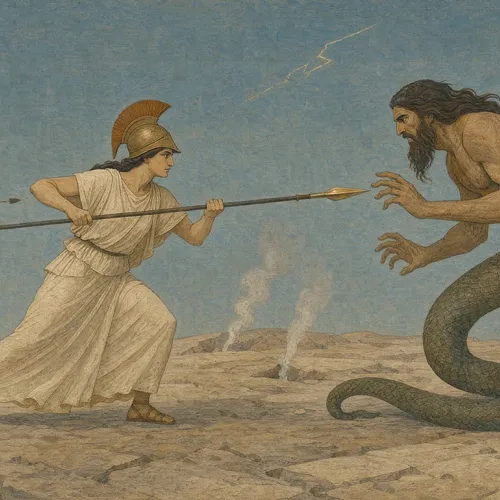
The Gigantomachy: The War the Gods Could Not Win Alone
The Gigantomachy was the war between the Olympian gods and the Giants. A prophecy said the gods could not win alone, so Heracles joined the battle. Trace the Giants' birth and defeat in ancient sources.
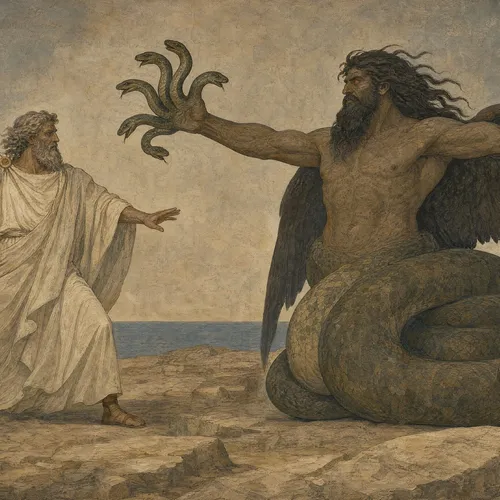
How Did Typhon Defeat Zeus—and Still Lose?
Typhon, Greek mythology's greatest monster, once defeated Zeus by tearing out his sinews. Follow the revolt that sent the gods fleeing and ended with Typhon buried beneath Mount Etna.
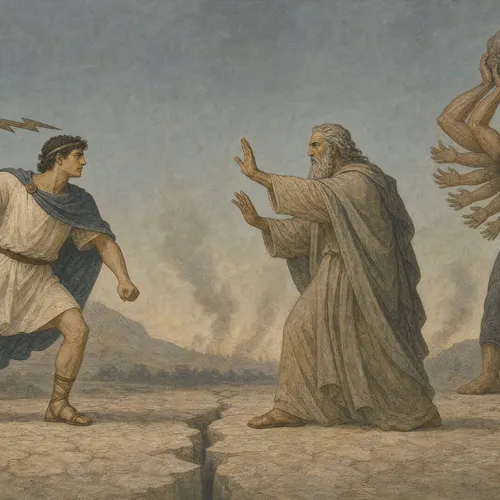
The Titanomachy: How Zeus Defeated His Father Cronus
The Titanomachy was a ten-year war between Zeus and his father Cronus for control of the cosmos. See how Zeus gained the thunderbolt, defeated the Titans, and established a new divine order.
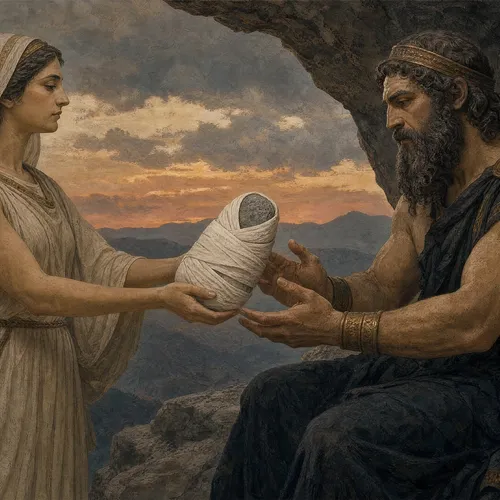
How Rhea Saved Zeus from Cronus, Who Swallowed His Children
Fearing a prophecy, Cronus swallowed each of his newborn children. Rhea hid Zeus and gave her husband a stone wrapped in swaddling clothes instead. Follow the deception that ended a father's rule.