

Pygmalion's Beloved 'Galatea' Originally Had No Name
Pygmalion fell in love with an ivory statue that Venus brought to life. Yet Ovid never calls her Galatea. Explore the transformation and how the later name became attached to the myth.

Art transcends reality, and the creator’s ideal harbors life—have you ever dreamed of such a miracle? This is the story of a lonely sculptor who was captivated by a perfect statue of a maiden created by his own hands, and whose love was fulfilled through divine intervention.
The Lonely King and the Ivory Maiden
Pygmalion, the King of Cyprus and a renowned sculptor, was disappointed in real women. He had witnessed women denying the divinity of Venus (Aphrodite) and, as punishment, losing their sense of shame and hardening in both mind and body (Ovid Metamorphoses 10.238–242). Believing that the female sex was naturally endowed with numerous vices, he refused to take a wife and spent a long time as a bachelor (Ovid Metamorphoses 10.243–246).
In his solitude, he poured his passion into art. With marvelous skill, he carved snow-white ivory, giving it a beauty that no woman could match. And, of all things, he fell in love with his own work (Ovid Metamorphoses 10.247–249). The statue was so exquisite that it looked as if a living maiden were merely standing still out of modesty.
Virginis est verae facies, quam vivere credas, et, si non obstet reverentia, velle moveri: ars adeo latet arte sua.
It is the appearance of a true maiden, whom you would believe to be alive, and, if modesty did not stand in the way, to be wanting to move: so effectively is art concealed by its own art.
(Ovid Metamorphoses 10.250–252)
Pygmalion’s love transcended mere appreciation. He often touched the statue, trying to verify whether it was flesh or ivory, yet he would not admit that it was ivory (Ovid Metamorphoses 10.254–255). He kissed it, spoke to it, embraced it, and even felt the illusion that his fingers were sinking into its skin. He offered gifts that girls delight in—shells, smooth pebbles, lilies, and drops of amber—and adorned the statue with clothes and gems (Ovid Metamorphoses 10.259–265). And at night, he called the statue the “companion of his bed” and laid it upon soft feathers (Ovid Metamorphoses 10.268–269).
The Festival of Venus and the Moment of Miracle
Eventually, the festival of Venus, celebrated most grandly throughout Cyprus, arrived. Heifers with white necks were offered as sacrifices, and incense smoke rose from the altars (Ovid Metamorphoses 10.270–273). Pygmalion approached the altar, but being too shy, he could not directly ask, “Give me the ivory maiden as my wife.”
“si di dare cuncta potestis, sit coniunx, opto” (non ausus “eburnea virgo” dicere) Pygmalion “similis mea” dixit “eburnae.”
“Ye gods, if you can grant all things, I wish that my wife may be” (not daring to say “the ivory maiden”), Pygmalion said, “one like my ivory woman.”
(Ovid Metamorphoses 10.274–276)
However, golden Venus herself was present at this festival and understood the true intent of his prayer. As a sign of the goddess’s favor, the flame flared up three times and extended its tip high into the sky (Ovid Metamorphoses 10.277–279).
Returning home, Pygmalion hurried to the statue with a heart full of expectation and anxiety, and kissed its lips. Then, warmth was felt on the lips. When he kissed her again and touched her breast with his hand, the ivory that should have been hard softened, sinking in response to the pressure of his fingers (Ovid Metamorphoses 10.280–284).
temptatum mollescit ebur positoque rigore subsidit digitis ceditque, ut Hymettia sole cera remollescit tractataque pollice multas flectitur in facies ipsoque fit utilis usu.
The ivory, having been touched, grows soft and, its rigidity laid aside, yields to the fingers and gives way, just as Hymettian wax grows soft again in the sun and, handled by the thumb, is bent into many shapes and becomes useful by use itself.
(Ovid Metamorphoses 10.283–286)
It was no longer ivory. When touched with a thumb, the pulsing of veins was felt (Ovid Metamorphoses 10.289). Pygmalion offered thanks to Venus with overflowing words and finally pressed his own mouth against a mouth that was no longer false. The maiden felt the kisses and blushed; raising her timid eyes to the light, she saw the sky and her lover at the same time (Ovid Metamorphoses 10.291–294).
She is Not “Galatea”
In modern times, the statue loved by Pygmalion is often called by the name “Galatea.” However, in the ancient source, Ovid’s Metamorphoses, she is given no proper name.
Who, then, was referred to as “Galatea” in ancient Roman literature? In fact, the Galatea appearing in the works of Ovid and Virgil is an entirely different being: a sea nymph.
In another chapter of Ovid’s Metamorphoses, Galatea herself recounts her tragic love to Scylla. She loved the beautiful youth Acis but was relentlessly courted by the one-eyed giant Polyphemus (Ovid Metamorphoses 13.750–755).
Also, in Virgil’s Eclogues, Galatea is mentioned as “Galatea, daughter of Nereus (god of the sea),” praised in the songs of shepherds or depicted as a capricious lover (Vergil Eclogues 7.37, 9.39).
In other words, in ancient texts, “Galatea” referred to a nymph living in the sea and was distinguished from the ivory woman carved by Pygmalion. The attachment of the name “Galatea” to the statue was an event in the history of reception occurring much later.
From Myth to the Modern Stage
The story of Pygmalion continues to exert a significant influence on later art. One of its most famous variations is arguably the early 20th-century play Pygmalion by George Bernard Shaw. This play later came to be loved around the world as the musical and film My Fair Lady.
From a silent statue that is merely beautiful to a human being with a will of her own. The myth of Pygmalion, while changing its form, continues to question the eternal tension between the creator and the created.
More on Myths of Metamorphosis
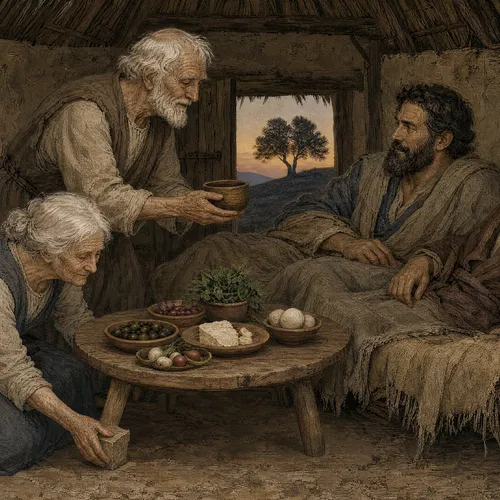
Why Did Baucis and Philemon Become Two Trees?
Baucis and Philemon were the only poor couple to welcome two gods disguised as travelers. As their reward, they became two trees standing together at death. Read Ovid's story of hospitality and devotion.
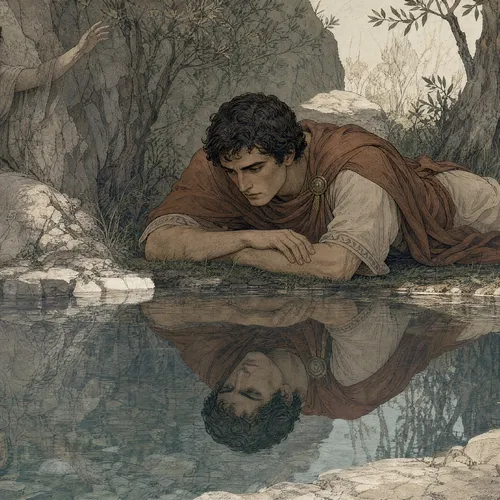
Narcissus and Echo: The End of Two Unrequited Loves
Narcissus fell in love with his own reflection and died beside the water; Echo, whom he rejected, faded until only her voice remained. Read their intersecting tragedies in Ovid's Metamorphoses.
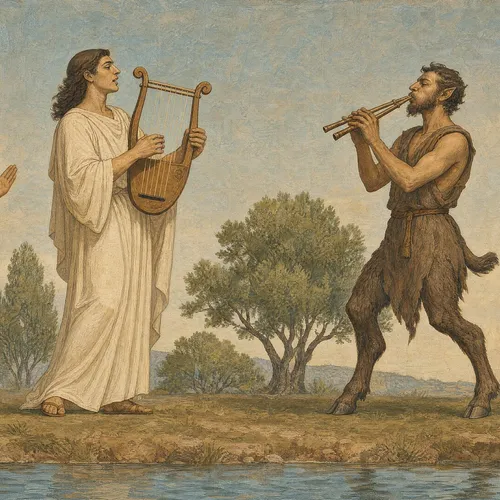
Apollo and Marsyas: The Price of Challenging a God
Marsyas found Athena's discarded pipes and challenged Apollo to a musical contest. After losing, he was flayed alive. Trace the instrument, the contest, and the brutal punishment in ancient sources.
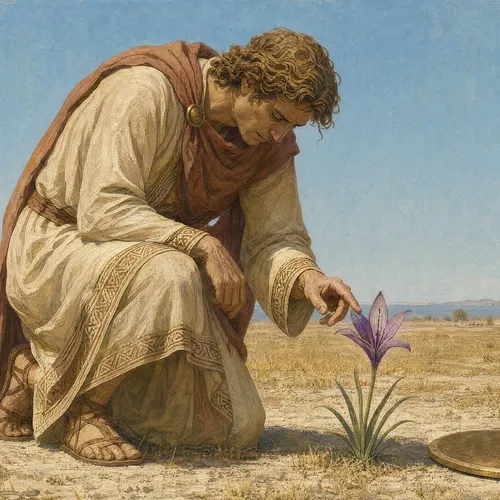
Apollo and Hyacinthus: A Youth's Death and a Flower of Grief
Hyacinthus died during a discus game with Apollo, and a flower rose from his blood. Explore the cry of grief inscribed on its petals and the variant in which a jealous wind god caused his death.