

Humanitext GEO Research Presented at the 40th Annual Conference of JSAI
6/12/2026
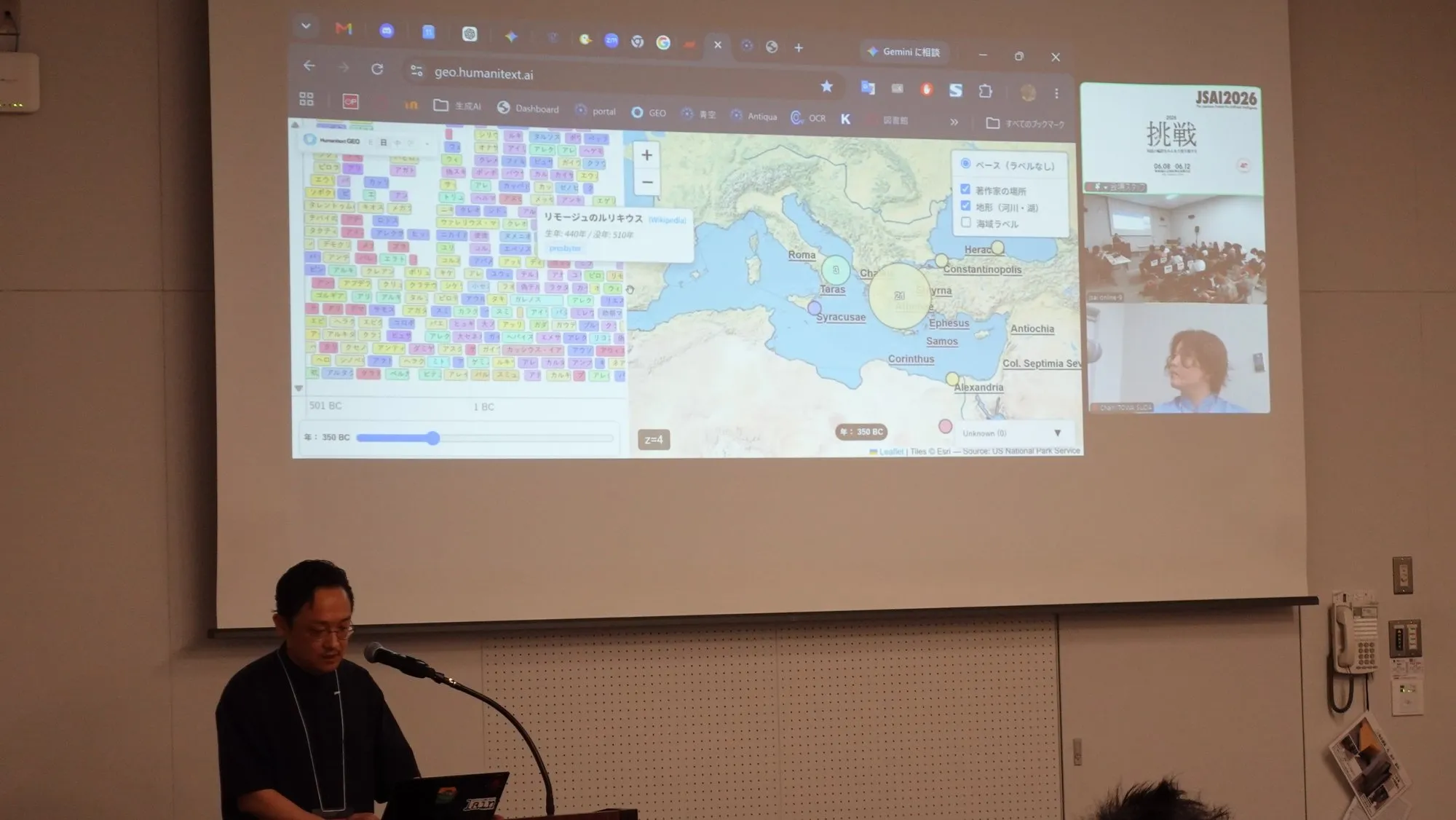
On June 11, 2026, at the 40th Annual Conference of the Japanese Society for Artificial Intelligence (JSAI 2026, held June 8–12 at G Messe Gunma in Takasaki), Ikko Tanaka presented the paper “Synchronic and Diachronic Exploration of the Classical World Centered on Cities: AI-Collaborative Support for Textual Interpretation Based on People, Time, and Place” (Ikko Tanaka, Jun Ogawa, Naoya Iwata) in the organised session “Humanities and AI.”
The paper reports the data-construction approach behind Humanitext GEO, released in March. The talk opened with the project’s origin story. After assigning students a report that required them to use Antiqua to investigate what an author’s contemporaries had said, Tanaka realised that identifying when and where authors outside one’s own speciality were active was itself a substantial hurdle. GEO grew out of that experience.
Knowing when and where classical authors were active is essential context for interpreting their texts. Ancient chronology, however, is often incomplete, while place names vary in spelling and administrative boundaries change over time. The study combines LLM-based extraction and candidate suggestions with human verification to build author metadata. It represents dates of birth, death, and activity as estimated ranges rather than fixed values, keeping the uncertainty inherent in historical sources explicit, and links geographic data to Pleiades identifiers.
The presentation included a live demo: moving the year slider to 350 BC brought up authors active across the Mediterranean world on a synchronised map and timeline. Humanitext GEO treats cities as nodes of intellectual activity: selecting a city and a period brings the authors and texts connected with them into view, while retrieval-augmented generation grounds interpretation in relevant sources. The talk presented this vision of reconstructing intellectual history from cities to an audience of AI researchers.