

Presentation at MEXT Committee on Humanities and Social Sciences
12/4/2025
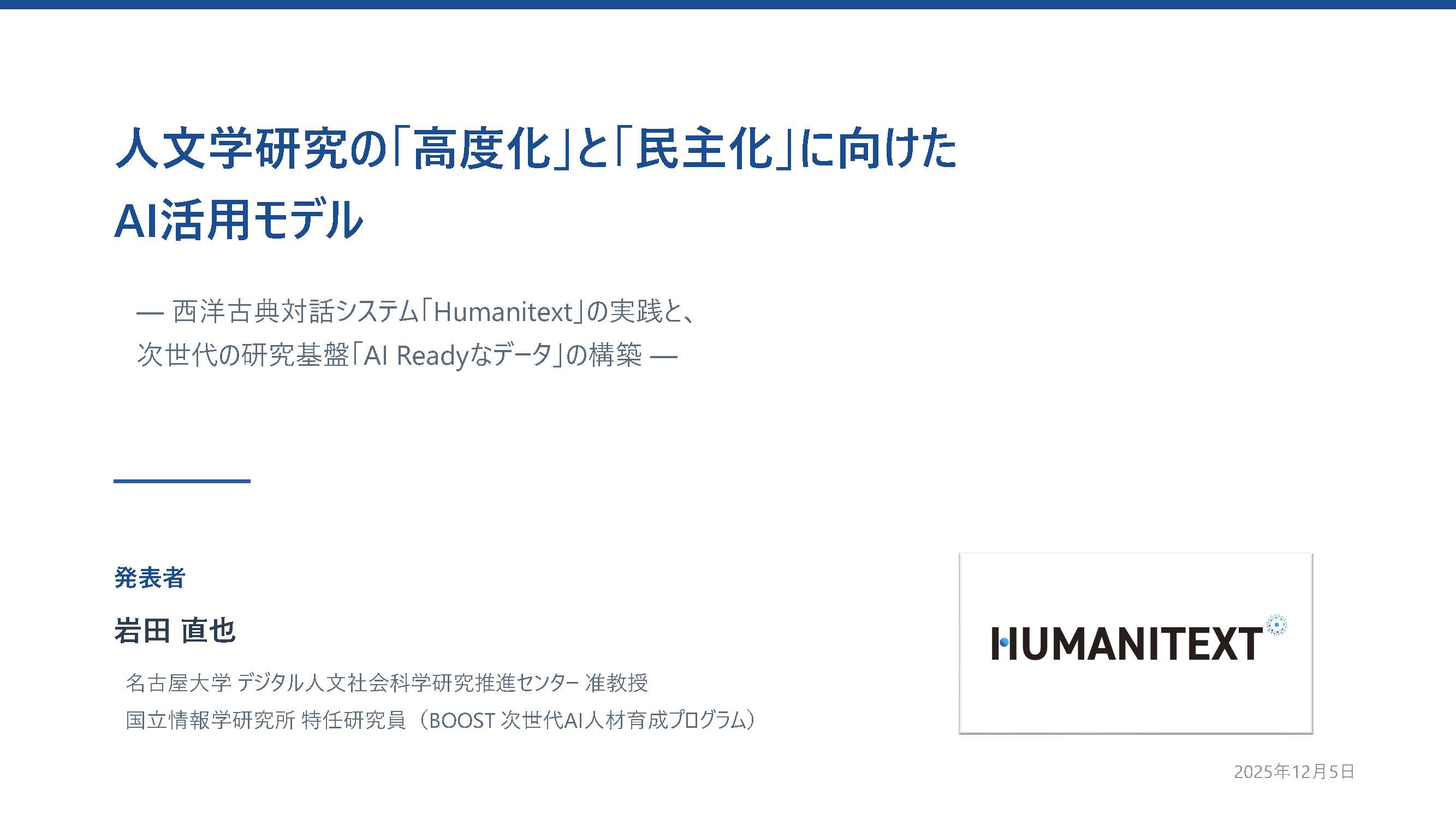
On Friday, December 5, 2025, Naoya Iwata, Associate Professor at the Center for Digital Humanities and Social Sciences, Nagoya University, and core member of the Humanitext project, will present at the “28th Committee on Humanities and Social Sciences” organized by the Ministry of Education, Culture, Sports, Science and Technology (MEXT).
The committee focuses on the utilization of DX (Digital Transformation) and AI in humanities and social sciences research, discussing the future direction of academic research in Japan.
Overview of the Presentation
Under the title “AI Utilization Model for ‘Advancement’ and ‘Democratization’ of Humanities Research,” Iwata will discuss the implementation of the Western Classics Dialogue System “Humanitext” and the construction of “AI Ready Data” as a next-generation research infrastructure.
Key topics include:
1. Implementation of the “Humanitext” System
The presentation will introduce Humanitext, a RAG (Retrieval-Augmented Generation) system that extracts semantically optimal texts from over 1,000 works by 100 classical authors in response to user queries. Using our proprietary “Context-Oriented Translation” technology, the system generates intermediate data that is easier for AI to understand, achieving high-precision retrieval even for low-resource languages like classical Greek and Latin. A crucial feature is that every AI response is linked to a primary source, ensuring the verifiability required for academic research.
2. Transition to “AI Ready” Data Infrastructure
While the TEI/XML format (tree structure), which has been mainstream in digital archives, is suitable for human viewing and preservation, it is prone to fragmentation and ill-suited for AI inference. The presentation advocates for restructuring this data into “Knowledge Graphs.” By defining entities and interpretations as nodes in a multilayered network, we can transform data into an “AI Ready” structure that allows for advanced AI reasoning.
3. The “Winning Strategy” for Humanities Researchers
Professor Iwata argues that the “winning strategy” for the humanities in the AI era lies not in competing over computational resources for LLM development, but in the quality of the “context” (domain knowledge) input into the AI. He will also emphasize the urgent need to cultivate a new generation of researchers who act as “Architects”—scholars capable of designing data structures and verifying AI outputs—in addition to possessing traditional research skills.
The Humanitext project aims to provide new options to the global community as a Japan-led innovation, enhancing the international presence of humanities research.
Event Information
- Event: 28th Committee on Humanities and Social Sciences, Council for Science and Technology
- Date: December 5, 2025 (Fri) 16:00 - 18:00 JST
- Format: Online
- Topic: Utilization of DX and AI in Humanities and Social Sciences Research
For more details, please refer to the official announcement by MEXT.