

Report on the 10th Research Conference of the Digital Archive Society
1/24/2026
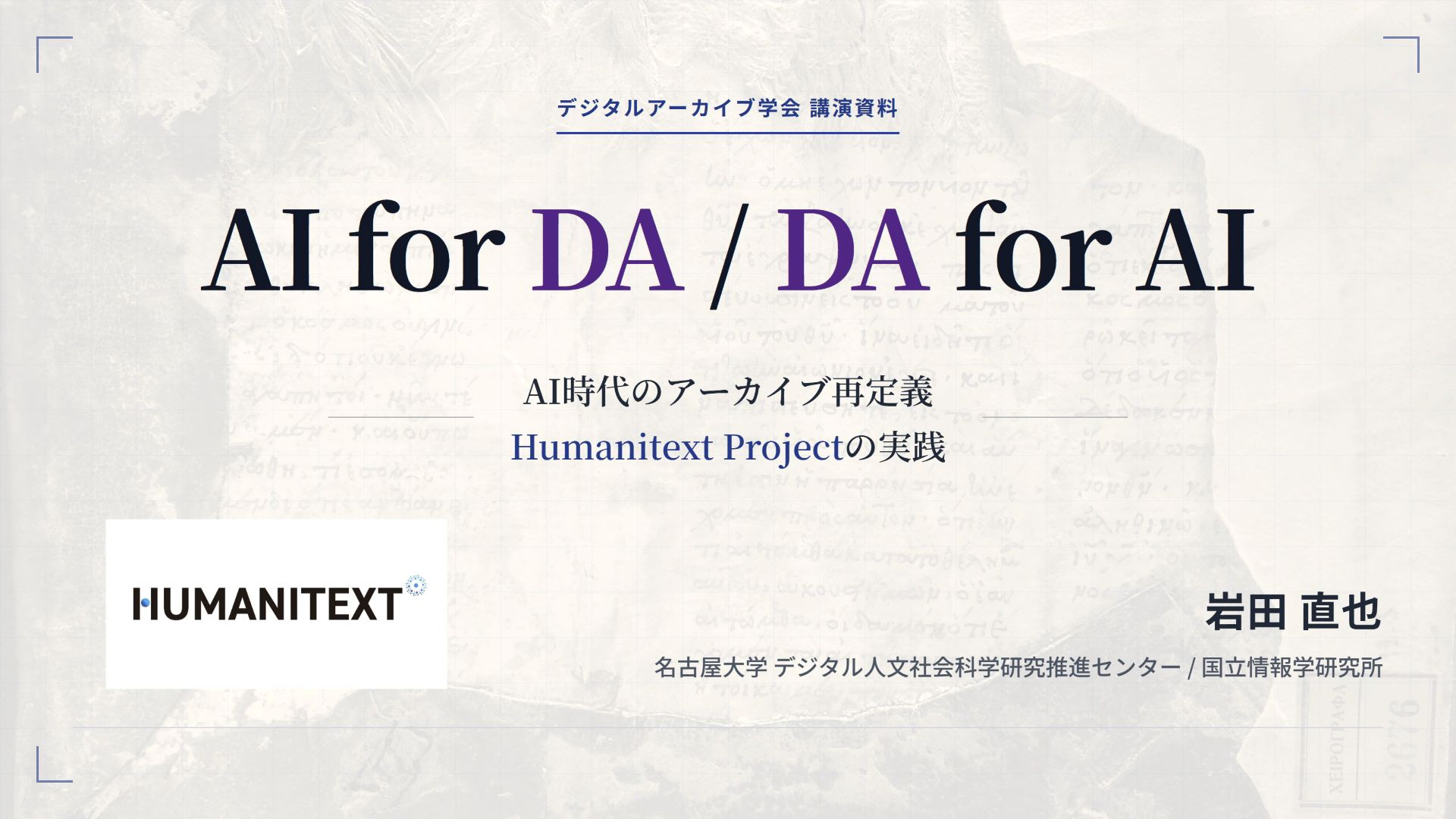
In January 2026, Naoya Iwata (Nagoya University), a core member of the Humanitext project, presented at the “10th Research Conference of the Japan Society for Digital Archive” held at Hitotsubashi Hall in Chiyoda, Tokyo.
The conference explored the possibilities of digital archives from a cross-disciplinary perspective. The Humanitext project reported on its practices and future outlook in two sessions: the Opening Act and the Satellite Planning Session.
Opening Act: AI for DA / DA for AI
In the Opening Act “AI for DA / DA for AI” held on Friday, January 9, discussions focused on the bidirectional relationship between AI and digital archives.
The Humanitext project advocated for the importance of “DA for AI,” redefining Digital Archives (DA) as a reliable foundation of knowledge (Source of Truth) for AI.
With the spread of Large Language Models (LLMs), the risk of hallucination has become a significant challenge. We emphasized that rigorously edited primary sources and text data structured with TEI (Text Encoding Initiative) play a crucial role in “Grounding,” providing a basis for AI reasoning.
At the same time, we presented Humanitext’s cyclical model that leverages “AI for DA,” where AI dramatically lowers the costs of OCR and structuring. This approach reduces the cost of “creating” archives while providing new semantic access for “using” them.
Satellite Session: Making Humanities Texts “AI Ready”
Prior to the main conference, on Tuesday, January 6, we also presented at the Satellite Planning Session titled “Possibilities of Digital Archives Opened Up by Text: Practice of Generation, Structuring, and Utilization.”
Based on the case study of the “Humanitext Antiqua Project,” we explained methods to realize access to “meaning,” which has been difficult to achieve with conventional keyword searches.
Specifically, we introduced a data model construction based on a three-layer structure:
- The Archive: A persistent preservation layer using TEI/XML.
- The Text Body: A context layer using DTS (Distributed Text Services) and vector search.
- The Knowledge Graph: A knowledge layer that graphs citation and reference relationships between texts.
By combining these into a GraphRAG (Graph-based Retrieval Augmented Generation) approach, we proposed a shift beyond simple information retrieval to “interpretative dialogue with citations,” where AI reasons while tracing philological contexts.
The Humanitext project will continue to work towards opening new horizons in humanities research by fusing digital archive technology with AI technology.